

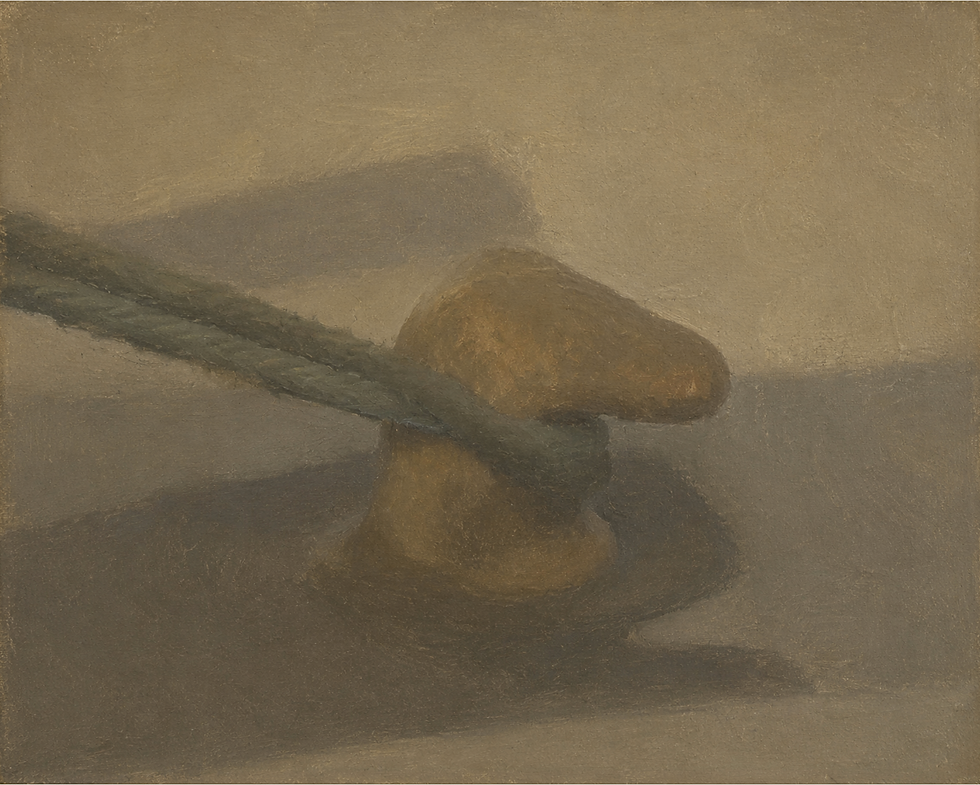
States of Ruin / Postcards from the edge
2026
In States of Ruin / Postcards from the Edge, Mark Mangion turns his attention toward architectural spaces suspended between presence and disappearance. Developed through a process that combines artificial intelligence image generation, personal photographic archives, and painting, the series examines the unstable relationship between memory, documentation, fiction, and representation in an age increasingly mediated by synthetic imagery.
Drawing upon borrowed news photographs, observational studies, and AI-generated source material, the works depict skeletal buildings, ruined interiors, deserted streets, and partially collapsed structures. Existing between documentary reference and painterly invention, the images resist clear distinctions between observed reality and constructed fiction. They appear simultaneously familiar and estranged, as though emerging from a collective memory whose origins can no longer be fully traced.
Rendered through muted tonal palettes, compressed atmospheres, and layered veils of paint, the architectural forms slowly surface from the canvas before receding again into ambiguity. Buildings are reduced to fragile geometries and unstable spatial relationships, producing environments that hover between construction and collapse, permanence and impermanence. The paintings refuse specific geographical identification, allowing them to function both as records of particular places and as broader reflections on contemporary conditions of uncertainty, displacement, and fragility.
Human presence remains largely absent. Yet traces of occupation persist throughout the works. Empty chairs, abandoned structures, damaged facades, unfinished interiors, and silent streets suggest lives interrupted, displaced, or forgotten. Rather than depicting conflict directly, the paintings focus on its residue—the physical and psychological aftermath embedded within architecture itself. Buildings become witnesses, carrying the accumulated weight of labour, violence, migration, memory, and time.
The series emerges at a moment when images of destruction circulate endlessly across global media networks. News photographs, satellite imagery, social media feeds, and AI-generated simulations increasingly collapse distinctions between evidence and fiction. Mangion responds to this condition not through immediacy but through delay. By translating images through processes of digital manipulation and painting, he introduces distance, slowness, and contemplation, shifting attention away from the spectacle of catastrophe towards quieter questions of endurance and survival.
Light plays a central role throughout the series. Dust-like atmospheres, softened edges, and restricted tonal ranges create suspended temporal conditions in which the images appear caught between past and future, ruin and reconstruction. The paintings exist in a state of unresolved becoming, refusing the certainty of either collapse or renewal.
While grounded in architectural observation, the works ultimately operate as psychological landscapes. Their fragmented structures and unstable spaces mirror broader concerns surrounding memory, displacement, vulnerability, and collective experience. Architecture becomes a surrogate for the body itself—scarred, fragile, resilient, and marked by the passage of history.
The subtitle Postcards from the Edge introduces a further layer of ambiguity. Traditionally associated with travel, tourism, and idealised representations of place, the postcard becomes here a fragmentary transmission from territories shaped by conflict, erosion, and uncertainty. These are not celebratory views but quiet dispatches from the margins of contemporary experience.
Positioned between representation and abstraction, painting and technology, documentation and imagination, States of Ruin / Postcards from the Edge reflects upon how places absorb history and how images continue to shape our understanding of the world. The paintings function as speculative archaeological reconstructions—not of specific events, but of conditions. Through their restraint and quiet intensity, they invite reflection on what remains after certainty disappears and on the fragile architectures through which human experience continues to unfold.