

The Search for a Space
Asylum Seekers
Marsa Migrant Open Centre, Malta
2007
Ruth Bianco, Mark Mangion, Chris Sant Fournier, Anthony Haughey
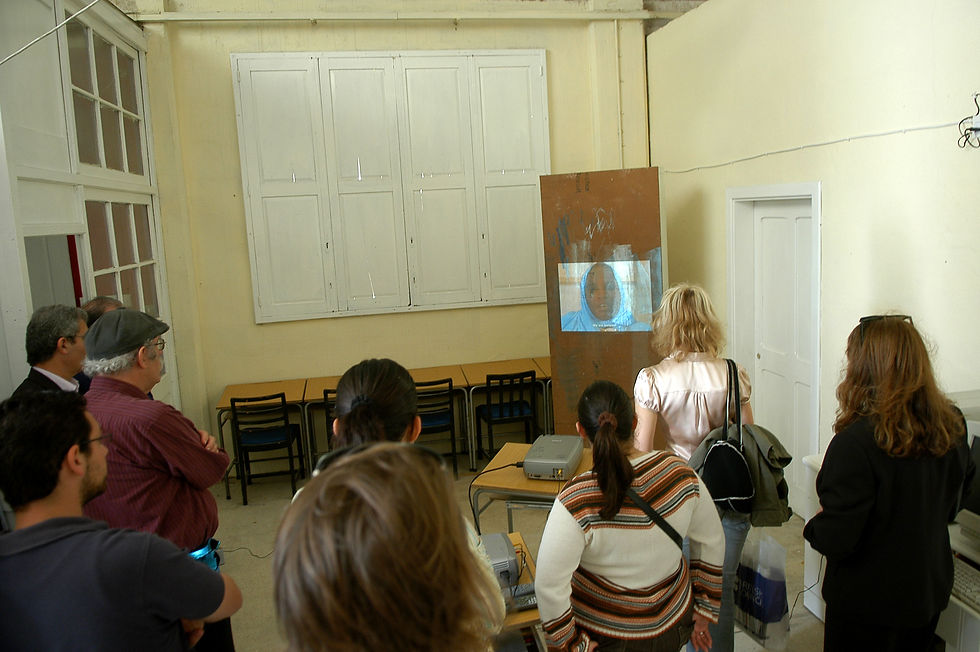
Asylum Seekers formed part of The Search for a Space, an ongoing curatorial project investigating alternative sites for the production and presentation of contemporary art. Developed within the Marsa Migrant Open Centre, the exhibition engaged directly with issues of migration, race, displacement, integration, and belonging, situating artistic practice within a functioning environment shaped by uncertainty, transition, and political tension.
Rather than occupying a neutral gallery setting, the project was conceived as a temporary intervention within the lived reality of the centre itself. Operating through a laboratory-like structure, artists developed project-based works that responded to the social and architectural conditions of the site, culminating in a series of films, performances, and interventions embedded within the everyday spaces occupied by residents. The exhibition sought to work from within the fabric of the centre rather than simply represent it from a distance.
Central to the project was an investigation into the unstable relationship between place and identity. The migrant centre functioned as a transient environment, simultaneously temporary and permanent, public and private, visible and hidden. Within this context, artistic interventions introduced subtle disruptions that challenged established patterns of occupation and use. The necessary, the constructed, and the artificial collided with the existing reality of the site, creating moments in which the centre was invited to reflect upon its own function and condition.
The exhibition also examined the complex dynamics of spectatorship. Two distinct publics emerged within the project. The first consisted of the residents themselves, who became a public within their own living environment. The second was the local audience, whose entry into the centre transformed them into temporary outsiders occupying a space that was not their own. This inversion of familiar social relationships destabilised conventional notions of host and guest, observer and observed, creating a situation in which visibility, power, and belonging were continually renegotiated.
Questions surrounding performance and representation remained central throughout. The presence of visitors inevitably altered the social dynamics of the site, producing a condition in which everyday life and artistic gesture became difficult to separate. Residents found themselves positioned within a framework of observation, while visitors were confronted with their own role as intruders within a highly charged social environment. The exhibition occupied this fragile territory between cultural integration and disintegration, proximity and distance, empathy and discomfort.
As part of The Search for a Space, Asylum Seekers extended the notion of exhibition-making beyond conventional institutional frameworks. Rather than presenting migration as an external subject, the project created a space in which artistic production and lived experience intersected directly. In doing so, it proposed the exhibition itself as a site of encounter, negotiation, and critical reflection.
Ultimately, Asylum Seekers examined how contemporary art might operate within spaces shaped by political realities and human vulnerability. Through its engagement with migration, place, and belonging, the project challenged assumptions about visibility, authorship, and audience, creating a framework through which questions of identity, displacement, and coexistence could be explored from within the conditions that produce them.