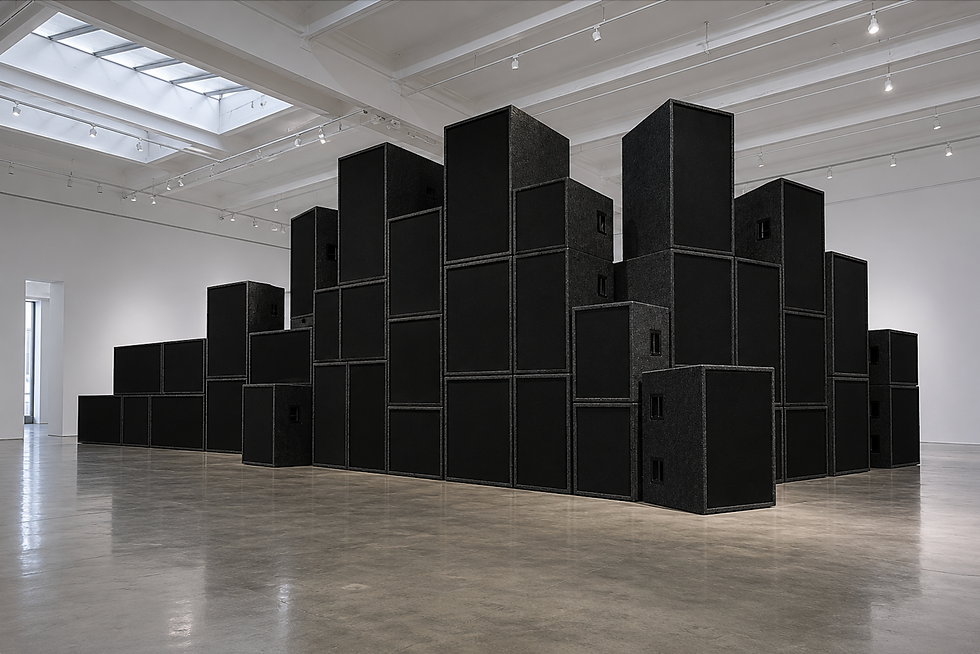


Explosion Proximity
2005
Explosion Proximity examines the relationship between threat, anticipation, and the politics of perception through a deceptively simple sculptural and sonic intervention. At the centre of the work stands a towering stack of stadium speakers, their imposing physical presence immediately evoking systems of public address, crowd control, propaganda, celebration, and emergency communication. As an object, the sculpture possesses a stark formal authority, drawing attention to its scale, repetition, and industrial materiality. Yet the work's primary force resides not in what is seen, but in what might happen.
At undefined intervals, a recorded explosion reverberates through the speaker tower. The sound is sudden, violent, and unpredictable. Its occurrence cannot be anticipated, and it interrupts the space without warning. What initially appears as a static sculptural installation is transformed into a temporal and psychological experience governed by uncertainty. The viewer becomes acutely aware of waiting, listening, and anticipating, inhabiting a heightened state of alertness that persists even during periods of silence.
Mangion's use of sound is significant. The explosion is detached from any visible event or source, existing as a disembodied acoustic phenomenon. There is no destruction, no smoke, no spectacle, only the sensory impact of a sound associated with violence and catastrophe. By separating the sound from its visual counterpart, the work exposes the ways in which fear often operates through anticipation rather than direct experience. The threat is imagined as much as it is heard.
The installation also extends beyond the physical boundaries of the gallery. The low frequencies and sudden detonations bleed into the surrounding environment, reaching audiences who may have no knowledge of the work itself. In this way, Explosion Proximity destabilises the distinction between artwork and public space, implicating both viewers and passers-by within its field of experience. The gallery ceases to function as a protected site of contemplation and instead becomes connected to wider social and political realities.
At a moment when contemporary life is increasingly shaped by distant conflicts, mediated violence, and perpetual states of emergency, the work can be understood as a reflection on the normalisation of threat. News cycles, political rhetoric, military interventions, and acts of terrorism have conditioned societies to live with the possibility of sudden disruption. Explosion Proximity materialises this condition, transforming anticipation itself into sculptural form.
The stacked speakers function simultaneously as monument and warning. They embody the infrastructures through which power is projected and collective experience is orchestrated, while also acting as vessels for an invisible force capable of altering perception and behaviour. The work occupies a space between minimal sculpture and psychological theatre, using the economy of a single gesture to produce a profoundly affective encounter.
Ultimately, Explosion Proximity is less concerned with the event of the explosion than with the condition it creates. Through the interplay of object, sound, space, and duration, Mangion constructs an environment in which viewers become aware of their own vulnerability, attention, and expectation. The work transforms the gallery into a site of latent tension, revealing how the experience of threat often resides not in violence itself but in the persistent possibility of its arrival.