

Escape Drawings
2017 - Ongoing
In 2017, Mark Mangion began navigating a gradual return to painting through a series of intimate drawings that would ultimately lay the foundations for a new body of abstract work. Emerging after years primarily focused on film, photography, performance, and socially engaged projects, these drawings marked a significant shift towards a more introspective and materially driven practice.
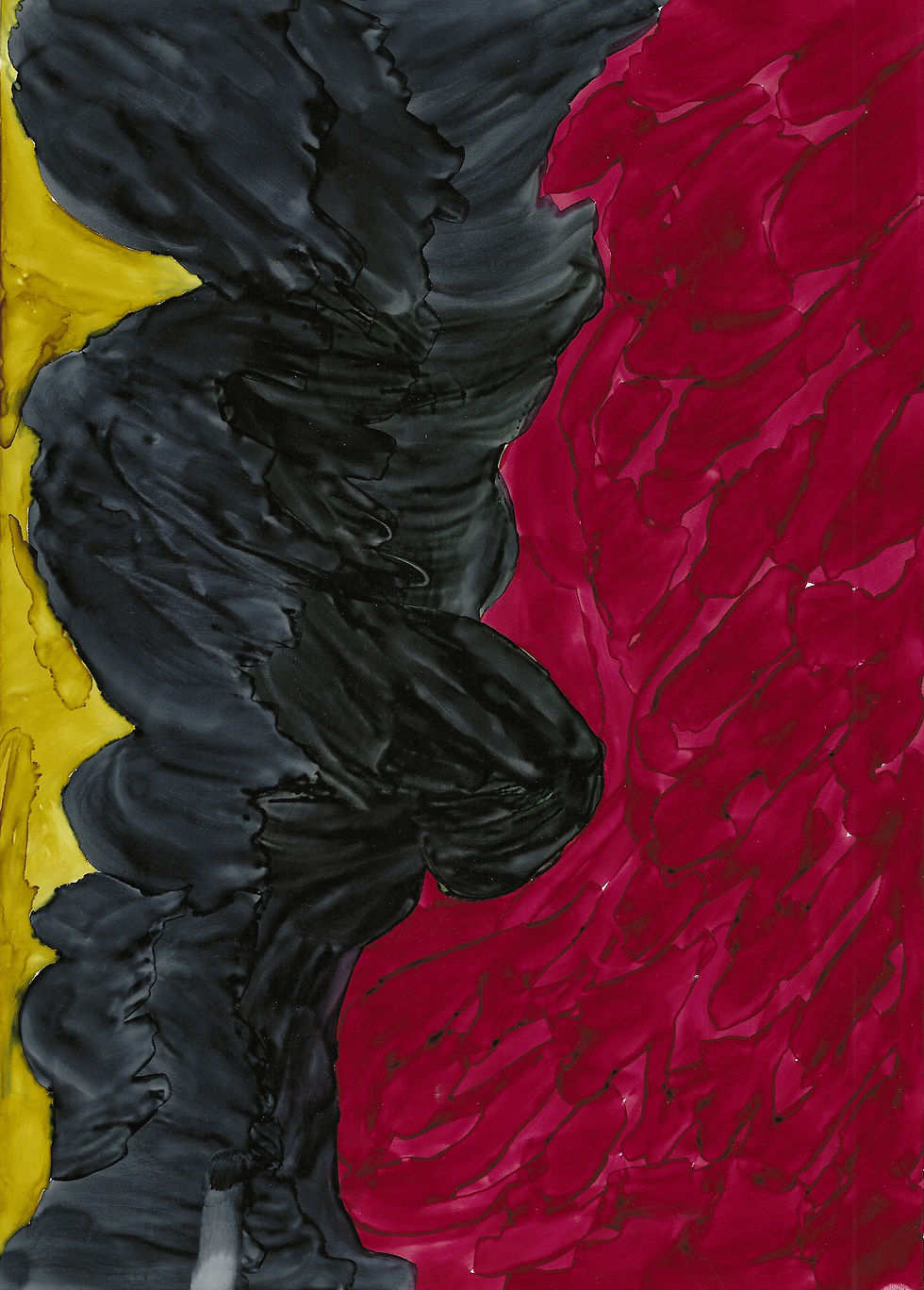
The works take as their starting point an unobserved and imagined landscape—places that appear familiar yet remain impossible to locate. Executed in saturated pen on paper, the drawings are composed of rough, instinctive marks that accumulate into fragmented topographies and unstable terrains. Neither fully abstract nor representational, they occupy an ambiguous space where traces of landscape emerge only to dissolve again into colour, gesture, and surface.
These small-scale works function less as depictions of specific places than as psychological and emotional geographies. Freed from direct observation, the drawings evolve through intuition, memory, and association, allowing form to emerge through a process of discovery rather than description. Dense passages of colour sit alongside open areas of paper, creating rhythms of compression and release that suggest movement through unknown territories.
While modest in scale, the drawings reveal many of the concerns that would come to characterise Mangion's later return to painting: an interest in porous spaces, fragmented narratives, material experimentation, and the relationship between internal states and imagined landscapes. They represent a departure from the social and political specificity of earlier projects while retaining a sensitivity to uncertainty, displacement, and the construction of place.
Rather than illustrating the world, these works propose alternative spaces of possibility. They are landscapes without coordinates, suspended between memory and invention, presence and absence. As such, they can be understood as both a return and a beginning—an exploratory body of work through which painting re-emerged as a means of thinking through perception, materiality, and the complexities of lived experience.