

Early Paintings
1998 - 2001
Produced during his years at Parsons School of Design in New York City, these early paintings reveal Mark Mangion's initial engagement with conceptual strategies and the potential of painting as a site for psychological, political, and autobiographical inquiry. Emerging from a period marked by intense experimentation, the works navigate themes of illness, mortality, sexuality, identity, vulnerability, and mental health through a visual language that combines text, symbolism, humour, and confrontation.
Often employing rudimentary drawing, direct language, diagrammatic structures, and appropriated imagery, the paintings resist traditional notions of painterly expression. Instead, they function as propositions and investigations, positioning painting as a space where personal experience intersects with broader social and existential concerns. Everyday symbols, handwritten texts, bodily references, and found imagery become vehicles through which complex emotional and psychological states are explored.
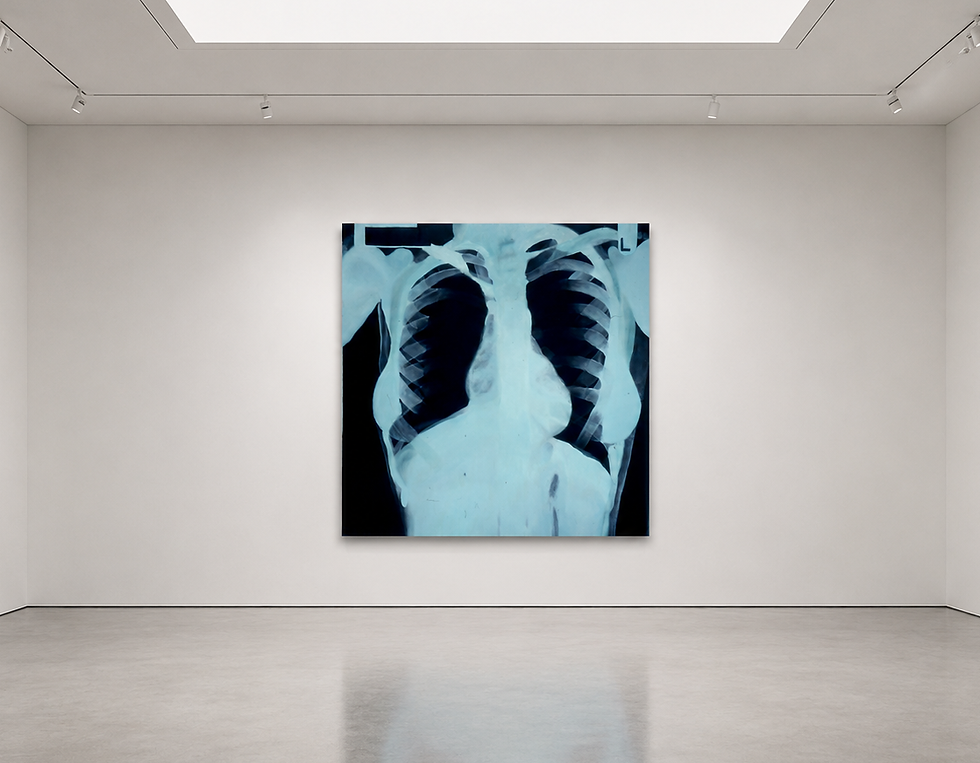
A recurring concern throughout this period is the body as a site of fragility and uncertainty. This is particularly evident in a series of paintings derived from medical imagery, including a large-scale work based on an X-ray of the artist's mother during her prolonged battle with cancer. Rendered in luminous tones that echo the clinical language of radiography, the painting transforms a diagnostic image into a haunting portrait of absence and vulnerability. Suspended between documentation and abstraction, the work confronts the viewer with the body not as a coherent whole but as a fragile structure marked by deterioration, memory, and impending loss.
Created years before Hospital Duration (2000), this painting reveals the origins of themes that would continue to resonate throughout Mangion's practice. Medical imaging becomes both evidence and metaphor, collapsing distinctions between personal grief and institutional systems of observation. The X-ray simultaneously records a living body and foreshadows its disappearance, transforming a clinical document into an image of profound emotional charge.
Elsewhere, language appears as a similarly unstable material. Works such as Cunt Man employ text and simplified imagery to examine the politics of gender, sexuality, and identity. Their apparent directness masks a deeper ambiguity, exposing how language operates as a mechanism of categorisation, desire, power, and social control. Humour, provocation, tenderness, and aggression coexist within the same pictorial space.
Viewed collectively, these early works reveal an artist grappling with some of the most fundamental conditions of human experience. Long before the socially engaged films, performances, and later abstract paintings, Mangion was already investigating the relationship between personal history and wider cultural structures. The body, mortality, psychological tension, and the instability of meaning emerge here in embryonic form, establishing concerns that would continue to evolve throughout his subsequent practice.
What remains striking about these paintings is their rawness. They refuse resolution or aesthetic comfort, instead embracing vulnerability, uncertainty, and contradiction. Positioned between confession and critique, they demonstrate an early commitment to art as a space where private experience can be transformed into a broader reflection on the complexities of being human.